


The Next Decade’s Winners Are Positioning Now: The Case for Dubai Real Estate
The strongest investment opportunities are often built on long-term fundamentals. Dubai’s real estate market is a compelling example.
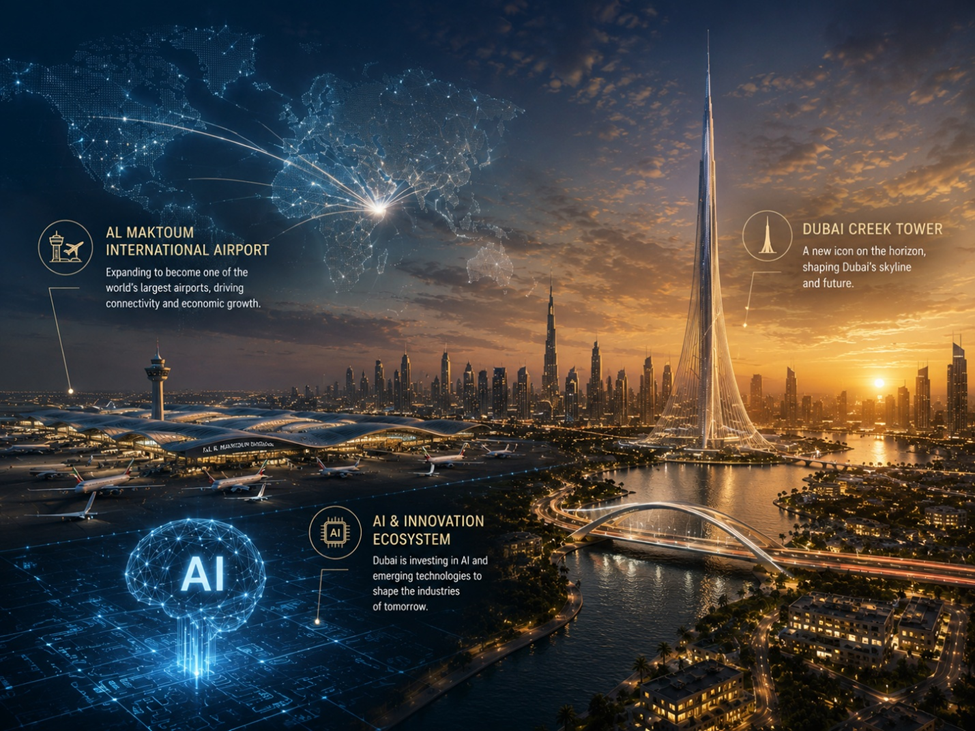
Most investors watch quarterly earnings. Many long-term investors focus on multi-year structural trends rather than short-term market movements. While short-term market noise dominates headlines, a quiet but profound structural shift is underway — and Dubai is emerging as one of the cities benefiting from this structural shift. Dubai’s transformation is no longer a growth story. It’s a permanence story. The fundamentals driving capital into the emirate—including population growth, infrastructure investment, business-friendly policies, and global capital migration—reflect long-term strategic planning aimed at strengthening Dubai’s position as a global business and investment hub.
Wealth Follows Long-Term Trends:
One of the most common mistakes investors make is focusing exclusively on the property purchase price while underestimating the full cost of acquisition and ownership.
Dubai demonstrates strong performance across all four factors. Capital doesn’t move because of headlines. It moves toward population growth, infrastructure investment, business migration, and global connectivity. Dubai is accelerating across every single one of these vectors simultaneously.
Consider the population dynamic alone. Dubai is now home to approximately 4 million residents, with population growth accelerating in recent years. The urban population continues to expand well beyond projections, driven by a convergence of economic opportunity, Golden Visa accessibility, and a high standard of living.
This is not transient tourism. These trends suggest an increasing number of individuals are relocating for long-term residency rather than short-term stays. Many incoming high-net-worth individuals—including entrepreneurs and business owners—are relocating their operations, obtaining long-term residency, establishing businesses, and purchasing property in Dubai. These trends distinguish Dubai from many earlier emerging real estate markets.
Dubai recorded over 270,000 real estate transactions worth AED 917 billion in 2025 — a 20% year-on-year increase, making it the strongest year in the emirate’s real estate history.
The World Isn’t Just Investing Here. It’s Relocating Here:
The Henley & Partners Private Wealth Migration Report identified the UAE as the world’s top destination for high-net-worth individual migration in 2025, with a projected net inflow of 9,800 millionaires — over 2,000 ahead of its nearest rival, the USA (+7,500). As the UK lost an expected 16,500 wealthy residents in the same period.
Income Matters. So Does Preservation. Dubai Delivers Both:
Most global real estate markets force investors to choose between yield and safety. Prime London residential property often generates relatively low rental yields compared with Dubai. Singapore imposes Additional Buyer’s Stamp Duty of up to 60% on certain foreign property buyers, dramatically compressing net returns. Dubai has no capital gains tax, no income tax on rental proceeds, and gross rental yields that generally exceed those of many established global property markets.
Across Dubai’s major residential communities, gross rental yields typically range between 6% and 8%. Apartments — particularly in high-demand areas such as Dubai Marina, Business Bay, and Jumeirah Village Circle — regularly exceed 7% gross. With no capital gains tax on exit and a dollar-pegged currency eliminating forex erosion, Dubai continues to offer a competitive yield profile compared with many established global cities.
There is a further dimension that few global markets can match: currency security. The UAE dirham has been pegged to the US dollar since 1997. For global investors managing portfolios in sterling, euros, or emerging market currencies, Dubai property denominated in a dollar-pegged asset provides structural preservation on top of income.
Dubai 2040 and the Next Wave of Infrastructure
Long-term investment opportunities are often supported by sustained infrastructure development and strategic urban planning. What Dubai is constructing today — in terms of transport, technology districts, AI initiatives, and new master communities — will shape the city’s investing ability for the next 20 years.
The Dubai 2040 Urban Master Plan provides the strategic framework for the city’s long-term development, focusing on sustainable urban expansion, enhanced mobility, increased green spaces, and improved quality of life. Complementing this vision are major infrastructure projects such as the Dubai Metro Blue Line, the expansion of Al Maktoum International Airport, continued investment in technology and innovation hubs including Dubai AI Campus, Dubai Internet City, and Dubai Silicon Oasis, and the development of new master-planned communities across Dubai South, Jebel Ali, and Mohammed Bin Rashid City.
Historically, established communities such as Palm Jumeirah, Downtown Dubai, and Dubai Hills Estate have experienced significant capital appreciation as infrastructure and amenities matured, illustrating how long-term development can contribute to property value growth. While past performance does not guarantee future results, many investors consider infrastructure-led development an important factor when evaluating long-term real estate opportunities.
- Dubai Metro Blue Line expansion underway
- Al Maktoum Airport expansion to handle 260 million passengers annually
- Expansion of technology and innovation hubs, including Dubai AI Campus (DIFC), Dubai Internet City, and Dubai Silicon Oasis
- New master communities across Dubai South, Jebel Ali, and Mohammed Bin Rashid City
- Dubai Real Estate Sector Strategy 2033 targets AED 1 trillion in annual transactions
The question facing global investors in 2026 is not whether Dubai has grown, but how its long-term fundamentals may shape future opportunities. Record infrastructure investment, continued high-net-worth migration, and increasing institutional participation suggest sustained investor confidence, although future market performance remains subject to broader economic conditions. Investors seeking long-term exposure may view the current phase of Dubai’s development as an opportunity to evaluate the market based on its long-term fundamentals.
Ready to Explore Dubai Real Estate?
Whether you are purchasing your first property in Dubai or expanding an existing portfolio, the SAYES team provides tailored guidance to help you make informed investment decisions. Speak with a SAYES advisor to explore opportunities aligned with your investment and residency goals.
Advisory Note & Disclaimer: This article is intended for informational purposes only and does not constitute financial, investment, legal, or tax advice. Investors should consult with qualified professionals before making any investment decisions.