


Dubai Real Estate Investment: 5 Questions Every Investor Must Ask
Learn the 5 essential questions every investor should ask before entering Dubai’s real estate market. Understand ROI, developer risk, exit strategy, costs, and long-term value before investing.
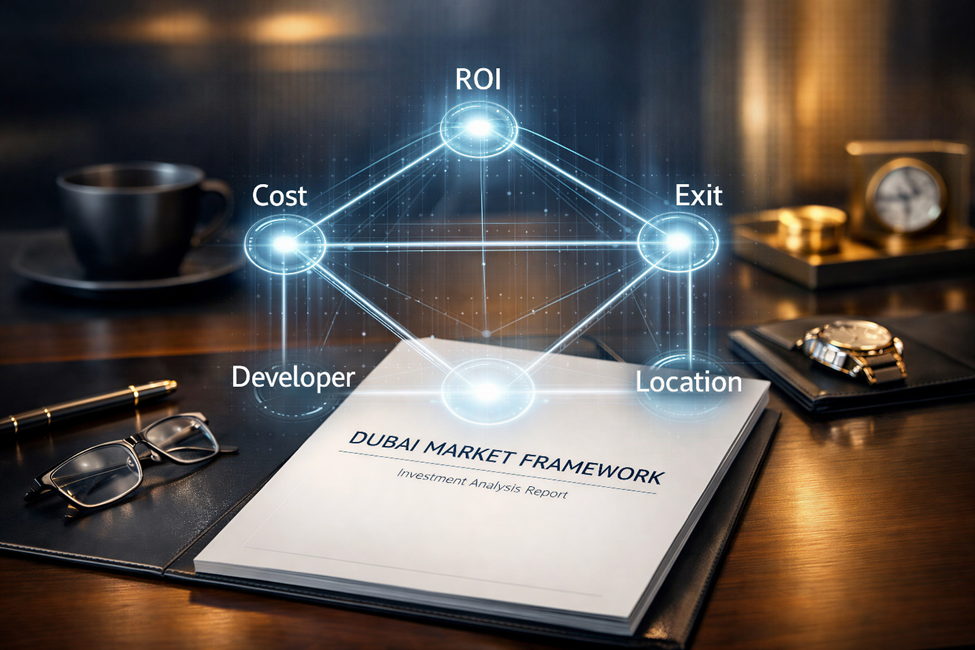
Dubai continues to attract global real estate investors seeking tax efficiency, strong rental yields, long-term residency benefits, and access to one of the world’s most internationally connected economies. Over the last decade, the emirate has evolved into a highly transparent and globally competitive property market supported by regulatory reforms, infrastructure expansion, and sustained international capital inflows.
However, strong market performance alone does not guarantee successful investment outcomes.
Many investors enter the Dubai property market based on launch pricing, headline rental yields, or short-term market sentiment without fully evaluating the underlying fundamentals of the asset they are acquiring. In a market with active off-plan supply, rapidly evolving micro-markets, and varying developer quality, under-informed investment decisions can lead to liquidity challenges, weaker-than-expected returns, or unnecessary exposure to execution risk.
Successful real estate investing in Dubai requires more than identifying attractive projects. It requires a disciplined framework for evaluating cost structure, return potential, location fundamentals, developer credibility, and long-term exit viability.
The following five questions provide a practical due diligence framework for investors seeking to approach Dubai real estate with greater clarity, confidence, and strategic discipline.
1. What is the True Total Cost of Ownership?
One of the most common mistakes investors make is focusing exclusively on the property purchase price while underestimating the full cost of acquisition and ownership.
In Dubai, the total investment cost extends beyond the asset value itself and may include:
- Dubai Land Department (DLD) fees
- Agency commissions
- Legal and conveyancing expenses
- Mortgage-related charges
- Service and maintenance fees
- Furnishing and fit-out costs
- Vacancy and operational reserves
Service charges, in particular, can vary significantly depending on the type of development, amenities offered, and long-term maintenance standards. In premium communities, these recurring costs can materially impact net rental income and overall yield performance.
A properly structured financial model should account for all acquisition and operational expenses before evaluating projected returns. Investors who fail to assess the true ownership cost often overestimate profitability and underestimate future liquidity pressure.
For example, two properties with similar purchase prices may deliver materially different net returns once operating costs and maintenance obligations are considered.
Understanding the full capital commitment upfront allows investors to compare opportunities more accurately and avoid undercapitalization — one of the most common drivers of forced or poorly timed exits.
2. What is the Realistic Return on Investment?
Headline rental yields can often create misleading expectations if evaluated without proper context.
Dubai has historically delivered comparatively strong rental yields, often ranging between 5% and 8% depending on asset class, location, occupancy levels, and management efficiency. However, gross yield figures alone rarely provide a complete picture of investment performance.
A disciplined investment assessment should focus on:
- Net rental yield
- Vacancy assumptions
- Service charge impact
- Maintenance costs
- Financing exposure
- Market liquidity
- Realistic appreciation potential
Many investors focus heavily on projected appreciation while overlooking future competing supply within the same submarket. In certain areas with aggressive off-plan launches, this can weaken resale liquidity even during broader market growth cycles.
Return expectations should therefore be stress-tested against:
- Market slowdowns
- Delayed handovers
- Rental softening
- Supply increases
- Extended resale timelines
Investors should also benchmark projected performance against comparable transaction data rather than relying solely on developer projections or launch marketing material.
A realistic, data-driven approach to ROI helps preserve capital discipline and reduces the likelihood of overpaying based on speculative assumptions.
3. What Drives Long-Term Property Value in This Location?
Location remains one of the most important drivers of both rental stability and long-term capital appreciation in Dubai real estate. However, strong investment locations are not defined solely by current popularity or short-term price momentum.
Long-term value is typically supported by:
- Infrastructure development
- Transportation connectivity
- Employment growth
- Community planning
- Population demand
- Accessibility to business hubs
- Lifestyle ecosystem maturity
Areas benefiting from integrated master planning and government-backed infrastructure expansion generally demonstrate stronger resilience across market cycles.
Conversely, locations driven primarily by speculative investor demand may experience sharper volatility once new supply enters the market.
Investors should assess whether future demand in a location is supported by genuine end-user appeal or temporary market sentiment.
For example, proximity to:
- Metro expansion
- Commercial districts
- International schools
- Healthcare infrastructure
- Waterfront developments
- Tourism corridors
can significantly influence both tenant demand and long-term resale potential.
A forward-looking, fundamentals-based approach enables investors to identify emerging growth corridors before they become fully priced into the market.
4. How Reliable Is the Developer?
In Dubai’s off-plan market, developer credibility is one of the most important risk variables investors must evaluate.
A project’s long-term success depends not only on its concept or pricing, but also on the developer’s ability to:
- Deliver on time
- Maintain construction quality
- Manage project financing
- Preserve long-term community standards
Before committing capital, investors should conduct thorough due diligence on the developer’s:
- Project delivery history
- Financial stability
- Construction track record
- Post-handover management standards
- Reputation within the market
Dubai’s regulatory framework offers important safeguards through the Dubai Land Department (DLD) and the Real Estate Regulatory Agency (RERA). Investors should verify:
- Developer registration
- Project approvals
- Escrow account compliance
- Construction progress transparency
These protections help reduce execution risk, particularly in off-plan transactions.
However, regulation alone should not replace independent due diligence.
Two projects may appear similar on launch, yet produce vastly different outcomes depending on build quality, operational management, and delivery execution. Investors who carefully evaluate developer credibility are significantly better positioned to distinguish between calculated investment risk and speculative exposure.
In a competitive and fast-moving market, developer quality often becomes one of the strongest determinants of long-term asset performance.
5. What is Your exit strategy?
Every successful real estate investment begins with a clearly defined exit strategy.
Whether the objective is:
- Long-term rental income
- Capital appreciation
- Portfolio diversification
- Short-term resale
- Residency planning
The investment structure should align with how and when capital is expected to be recovered.
Different strategies require different asset profiles.
For example:
- High-yield rental communities may suit income-focused investors
- Emerging growth corridors may offer stronger appreciation potential
- Ultra-prime assets may prioritize capital preservation and wealth positioning
Investors should evaluate:
- Market liquidity
- Likely buyer demographics
- Future competing supply
- Resale demand
- Transaction costs
- Holding period flexibility
An investment should also be stress-tested against less favorable scenarios, including:
- Slower market absorption
- Changing financing conditions
- Economic volatility
- Earlier-than-expected exits
Many investors focus heavily on acquisition opportunities without fully assessing exit efficiency. Yet liquidity often becomes the defining factor separating a profitable investment from a stagnant one.
A strong investment strategy does not simply consider how to enter the market — it considers how to exit it efficiently under multiple market conditions.
Implementation Framework
1. Define Investment Objectives: Clearly articulate your financial goals, risk tolerance, and investment horizon before evaluating any property. This foundational step guides all subsequent decisions.
2. Conduct Structured Due Diligence: Engage qualified legal and financial advisors to review contracts, ownership structures, and financial assumptions.
3. Market Specific Research: Conduct in-depth research into specific Dubai sub-markets, focusing on supply-demand dynamics, infrastructure plans, and demographic trends that influence long-term value.
4. Prioritize Developer Quality: Prioritize developers with a proven track record, strong financial health, and transparent communication. Utilize RERA’s resources to verify project and developer credentials.
5. Build a Realistic Exit Plan: Formulate a clear exit strategy from the outset, considering market liquidity, potential buyer demographics, and associated transaction costs to ensure optimal capital repatriation.
Frequently Asked Questions
1. Is Dubai real estate a good investment for foreign investors?
Dubai continues to attract international investors due to its tax-efficient environment, comparatively strong rental yields, expanding infrastructure, and investor-friendly ownership regulations. However, investment performance depends heavily on location selection, developer quality, and acquisition strategy.
2. What are the biggest risks in Dubai real estate?
Key risks include speculative pricing, oversupply in certain segments, developer execution risk, changing financing conditions, and unrealistic appreciation expectations. Proper due diligence significantly reduces these risks.
3. Is off-plan property in Dubai safe?
Dubai’s regulatory framework provides meaningful investor protections through escrow regulations and RERA oversight. However, investors should still independently assess the developer’s delivery history, financial stability, and project credibility before investing.
4. What rental yields can investors expect in Dubai?
Rental yields vary by location and asset class, though many areas historically deliver net yields that are comparatively attractive relative to other global gateway cities.
Conclusion
Dubai’s real estate market continues to offer compelling opportunities for international investors seeking long-term capital growth, income generation, and strategic global asset diversification.
However, successful investing requires more than identifying attractive launch prices or following market momentum.
The strongest investment outcomes are typically achieved by investors who apply a disciplined framework focused on:
- Total ownership cost
- Realistic return expectations
- Location fundamentals
- Developer credibility
- Long-term liquidity planning
In a market as dynamic and competitive as Dubai, disciplined due diligence is not simply a protective measure — it is a strategic advantage.
Advisory Note & Disclaimer: This article is intended for informational purposes only and does not constitute financial, investment, legal, or tax advice. Investors should consult with qualified professionals before making any investment decisions.
For investors evaluating Dubai real estate opportunities, a structured acquisition strategy can significantly reduce risk and improve long-term performance. Speak with a SAYES advisor to assess which Dubai investment opportunities align with your capital objectives, residency goals, and portfolio strategy.